Horns Nail Elbow Get: The Fake Handoff Dunk Play
 By Coach On·Updated November 15, 2026·16 min read·10 sources
Nail Elbow Get is a Horns set. The 1 passes to the 4 at the elbow, then runs at him for a handoff (the GET) that never comes. The defense collapses on the ball, so the 5 face cuts from the other elbow and the 4 hits him for a dunk.
By Coach On, CoachesPad. Broken down from the game film.
Most Horns plays live or die on the first action. The defense knows the ball is going to an elbow, and it knows a handoff or ball screen is coming next. Nail Elbow Get uses that knowledge against them. The guard runs at the elbow big as if he is coming back for the ball, every defender turns to play the handoff, and the other big walks in behind it for a dunk.
Creighton ran it against Rhode Island in the first round of the 2017 NCAA Tournament in Sacramento. It is two passes, one fake, and one cut. Below is how to set it up, why it works, what to do when the defense takes it away, and how to teach it in four practice steps.
Quick summary
| What it is | A Horns set where the guard fakes a handoff with the left elbow big, and the right elbow big face cuts to the rim behind the fake. |
|---|---|
| Formation | Horns, 4 high: 1 at the top, 4 and 5 at the elbows, 2 near the nail, 3 low on the left wing. |
| Who it is for | High school, college and strong club teams with a big who can hold the ball at the elbow and make a pass. |
| Best against | Man-to-man defenses that crowd the ball at the top of the key and help hard on handoffs. |
| Not for | Zone defenses. The play depends on defenders following their own man into the handoff. |
| Get the play | Share code RXQYJ3ZN in the CoachesPad app, or open it here. |
Terms used in this play
Coaches use these words differently from program to program, so here is exactly what they mean in this breakdown.
- Horns. A 1-2-2 alignment with the ball handler at the top of the key and two players (usually bigs) at the elbows. The two elbow players look like a pair of horns on the diagram. In the classic version the other two players sit in the corners; this play moves them.
- 4 high. In this play it means the 4 stays high at the elbow after the catch instead of dropping to the block. He is the passer, not a post-up option.
- Elbow. The corner where the free-throw line meets the lane line. There is one on each side.
- Nail. The middle of the free-throw line. Many courts have an actual nail or mark there that centers the basket, which is where the name comes from. Coaches also use it as a defensive help spot.
- Slot. The area between the top of the key and the wing, roughly above the elbow and outside the three-point line. Coaches draw the borders a little differently, but slot is "between the top and the wing."
- Wing. The perimeter area along the sideline, outside the lane at about free-throw-line extended, below the slot and above the corner.
- Iverson cut. An off-ball cut that runs across the top of the floor, over the elbows, from one side to the other. It is named after Allen Iverson, who used it constantly with the 76ers. Usually the elbow players screen for it; here both wings run it at once, swapping sides, mainly as a spacing move.
- DHO (dribble handoff). One player hands the ball to a teammate running past him, usually at close range. The handoff player becomes a screener the moment the ball changes hands.
- Get. A pass-and-follow action: you pass to a teammate, then chase the pass to get the ball back on a handoff. Some playbooks call it "throw and get" or "chase DHO." Be aware that some programs use "Get" for an elbow-to-elbow ball screen instead. In this play it means the guard's run back at the ball.
- Fake handoff (keep). The ball handler shows the handoff and keeps the ball. The point is to make defenders commit to the exchange that never happens.
- Face cut. A basket cut in front of the defender's face, between the defender and the ball. It is the opposite of a back cut, which goes behind the defender. Some coaches call it a front cut; in Europe you will hear "Danilovic cut."
- Pack-line / help defense. A man-to-man system where off-ball defenders sit inside an imaginary line about a foot inside the three-point arc, ready to help on the ball. We cover it in depth in our pack-line defense breakdown.
Personnel: what each spot needs
The play is simple, but it asks for specific skills at the two elbow spots. Put the wrong player at the 4 and it falls apart.
- 1 (point guard): Has to sell the Get. He runs at the 4 with pace and his hands up, like a guard who really wants the ball back. A guard whose handoffs normally lead to downhill drives makes the fake more believable, because the defense has to respect it.
- 4 (left elbow big): The most important player in the play. He catches at the elbow, faces up, protects the ball with two hands while a guard runs at him, and then delivers a pass to a cutter moving at full speed. Think of a skilled big who can pass, not a pure post scorer.
- 5 (right elbow big): Needs timing and finishing. He has to wait while the Get develops, then explode to the rim and catch in traffic. Good hands matter more than height here.
- 2 (near the nail): A shooter whose defender cannot sag off. 2 fakes going out to the right wing, then cuts back over the top to the left wing; his man has to turn and chase, and that empties the left side of the lane.
- 3 (low on the left wing): Another shooter. His Iverson cut pulls a defender across the floor and over the top of both bigs, away from where the dunk will happen.
The alignment
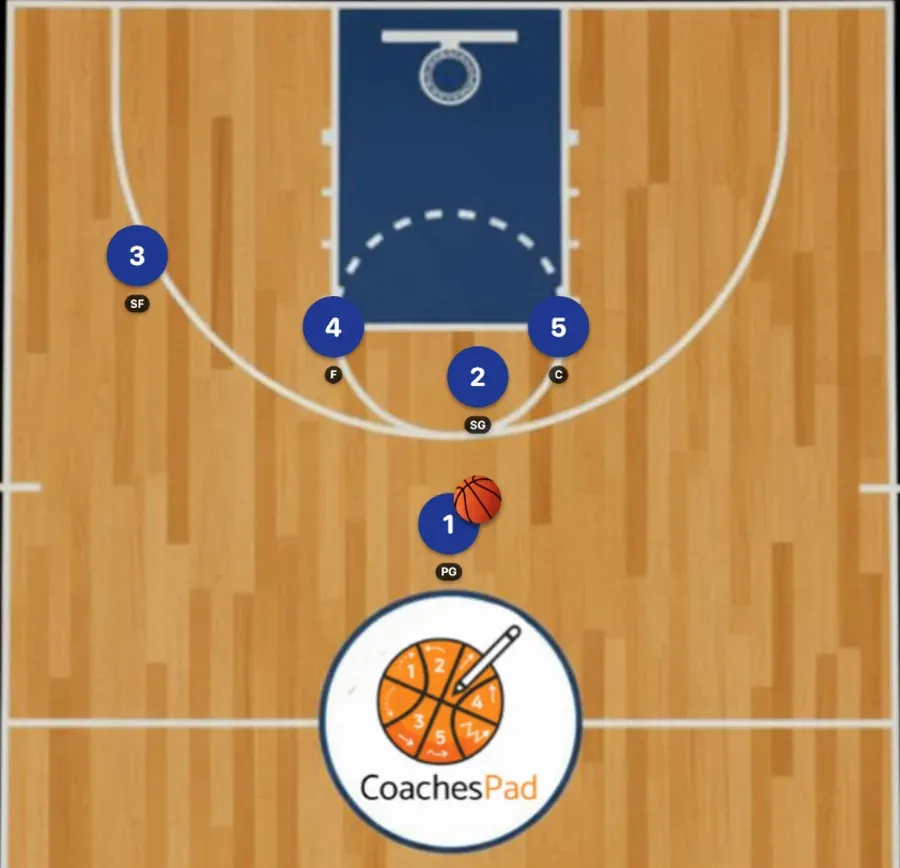
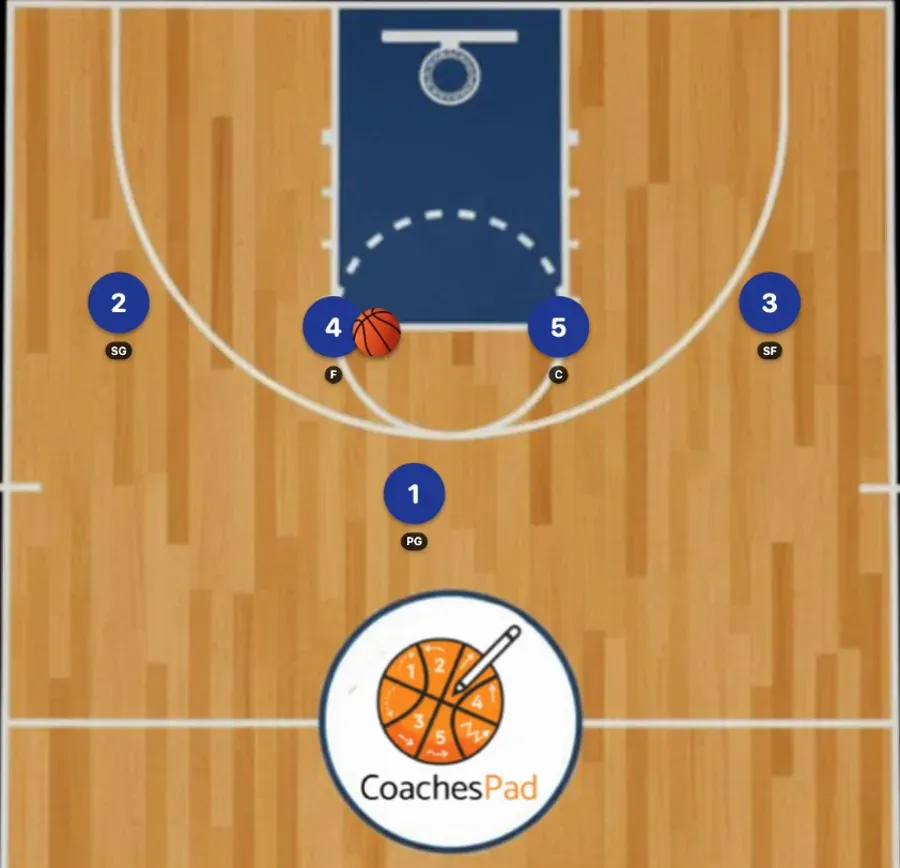
Start in Horns with the 4 high. 1 has the ball at the top of the key. 4 is at the left elbow and 5 is at the right elbow. 2 starts near the nail, just above the free-throw line, and 3 is low on the left wing.
Notice what is unusual: there is a player near the nail and nobody in either corner. That crowds the middle on purpose. The first action clears it, and 2's fake to the right side is what sells it.
Step-by-step
Step 1: Spacing (2's fake and the Iverson cut)
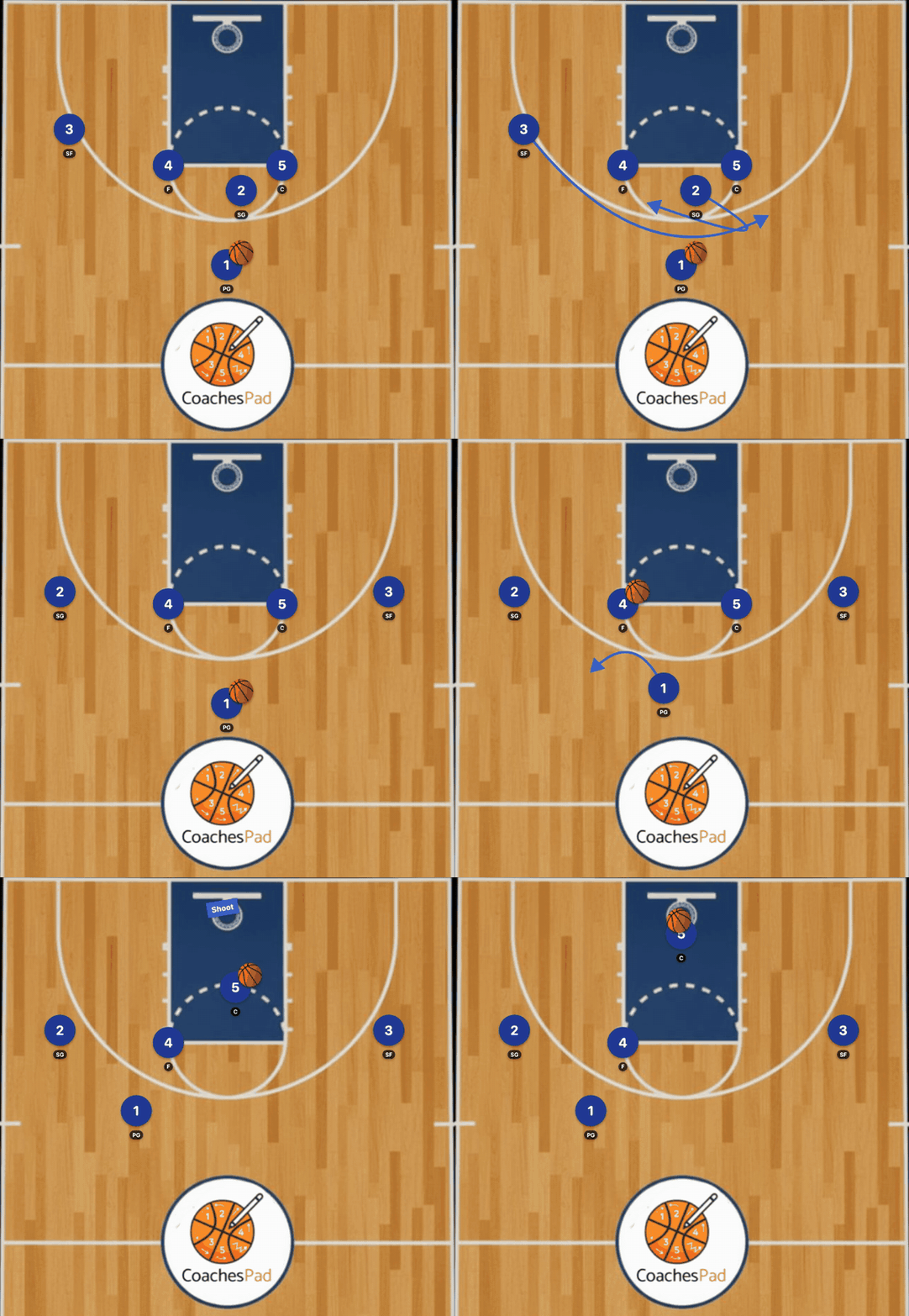
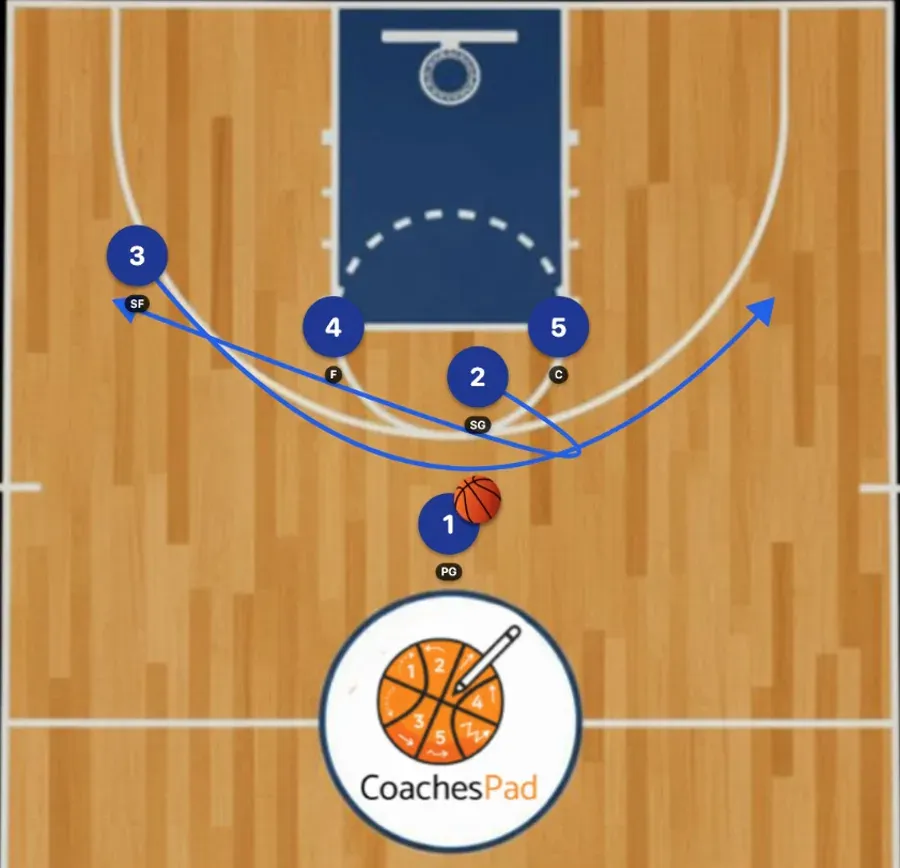
2 starts near the nail and fakes like he is going out to the right wing, then cuts back over the top of the elbows to the opposite (left) wing. At the same time, 3 comes from low on the left wing across the top the other way, an Iverson cut out to the right wing. Their paths cross above the free-throw line, so the two defenders have to chase through traffic.
Two things just happened. The middle of the floor emptied, and two perimeter defenders are now attached to shooters on the wings instead of sitting in the lane. The only players left near the paint are the two bigs and their defenders.
Step 2: Entry to the 4
1 passes to 4 at the left elbow. 4 catches, turns, and faces the basket. He stays high. He does not drop to the block or put the ball on the floor.
The face-up matters. A big who catches with his back to the basket cannot see 5's cut later. A big who faces up sees the whole floor and makes his defender guard him as a scorer.
Step 3: The Get (fake handoff)
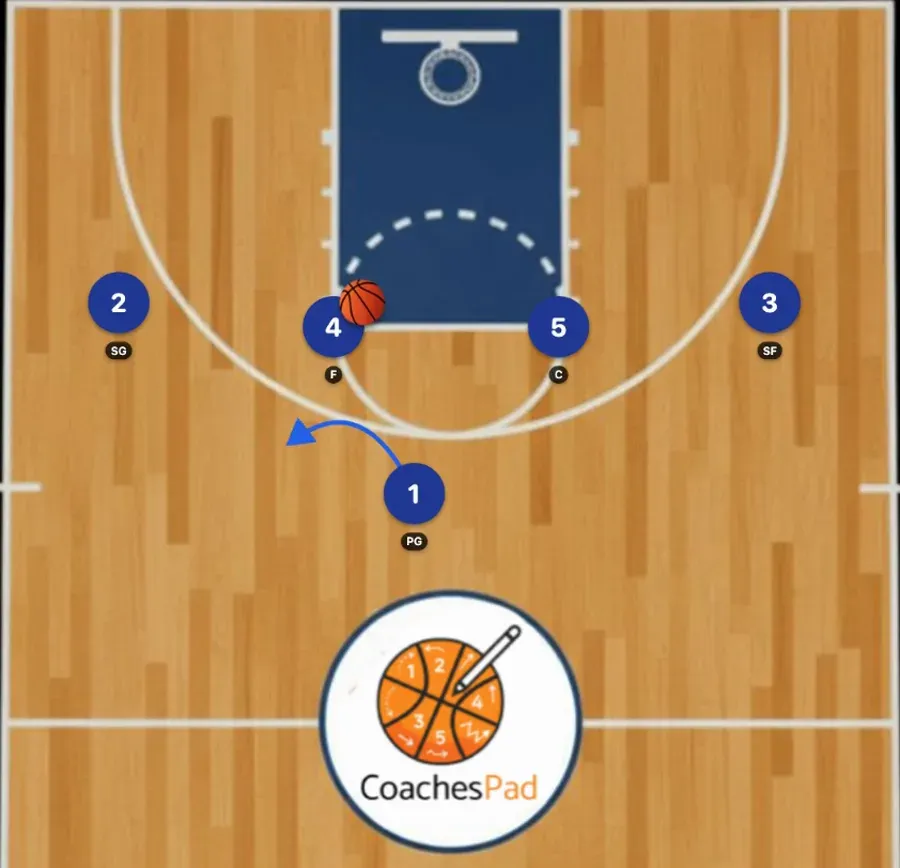
1 follows his pass and runs straight at 4, as if he is coming to get the ball back on a handoff. This is the action the defense has seen all season, and they turn to play it. 1's defender gets ready to fight over the handoff, and 5's defender starts to think about helping on 1's drive.
4 keeps the ball. 1 bounces out to the left slot, which keeps his defender occupied and gives 4 a safe outlet.
Step 4: The face cut
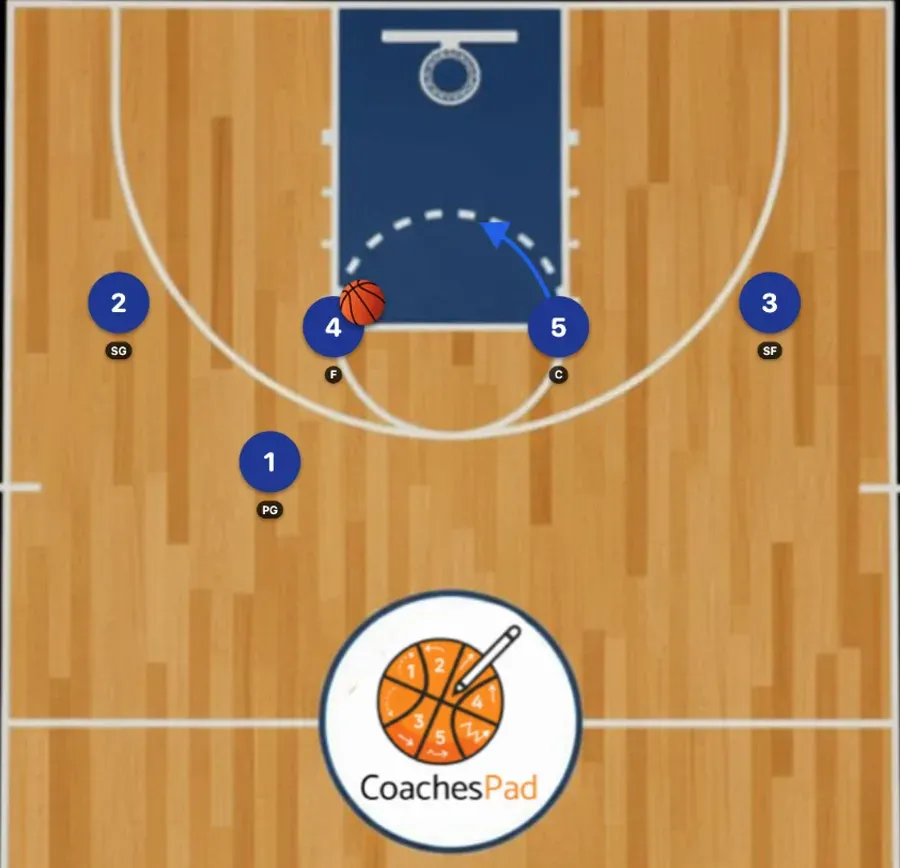
While the defense is turned toward the handoff, 5 face cuts from the right elbow straight to the rim, going in front of his defender's face. 4 hits him with the pass.
The timing cue for 5 is simple: he goes when 1 arrives at 4. That is the moment his defender's eyes are on the ball and his feet are pointed toward the handoff.
The pass has to be perfect. 4 is surrounded the moment the defense collapses, so the ball has to come out quick and away from every hand near him. On the film it is one fast, accurate pass, out of the reach of the defenders on the ball, and it lands where 5 can catch and finish in one motion. A slow or lobbed pass here gets deflected.
Watch what the defense does when it sees the fake. On the film, once Rhode Island realized there was no handoff, three defenders collapsed on 4 at the elbow. Even 1's defender sank in to help. That left two players open at the same moment: 5 on the face cut to the rim, and 1 spotted up outside for a shot. 4's read is simple. If the rim is open, hit 5. If 5's man recovers, kick it out to 1, whose man just left him.
Step 5: The finish
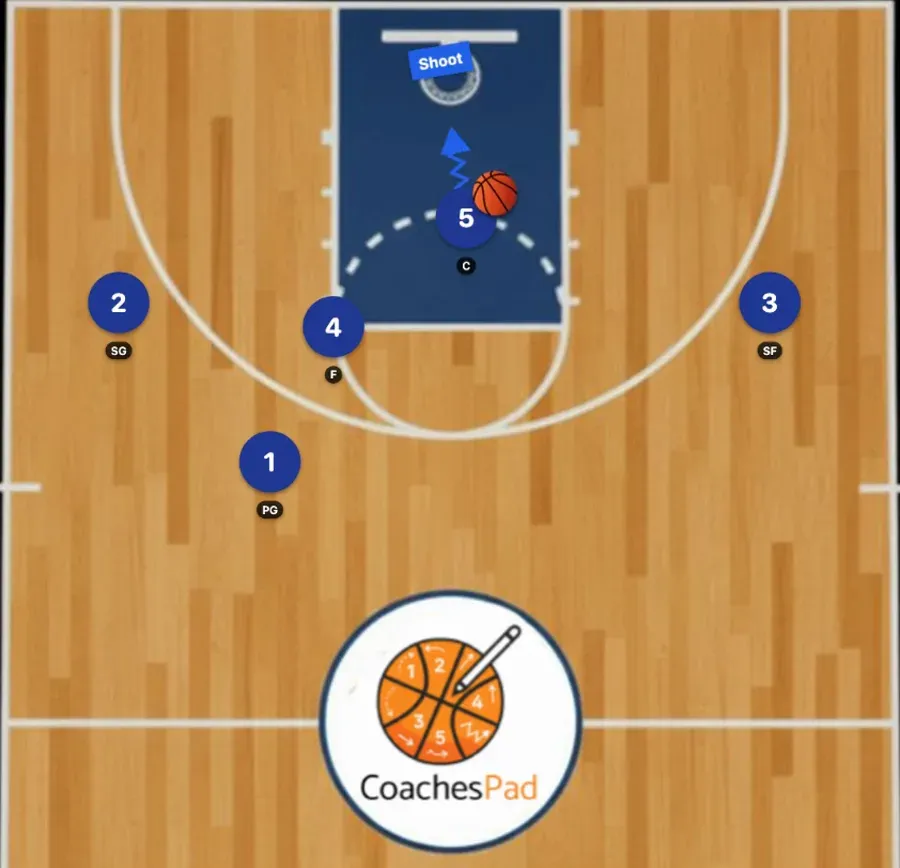
5 catches in the lane with nobody between him and the rim and dunks. If 5 cannot dunk, he finishes with two hands off two feet. A missed layup here wastes a perfect action.
Why it works
The fake turns into a collapse. When the defense realizes the handoff is not coming, its instinct is to swarm the ball. Three defenders on 4 means two Creighton players are open: 5 at the rim and 1 on the perimeter. The play gives the passer two answers, not one.
The fake looks exactly like the real thing. Pass to the elbow, guard chases for the handoff: defenses see this action from Horns every game. Scouting reports tell defenders to blow it up. That is why the fake works. The better the defense knows the handoff is coming, the harder it bites.
4 never gives up the ball. The handoff is a decoy. Because 4 is facing up and holding the ball, he can watch both actions and choose the open one.
The lane is empty. The cuts across the top take both wing defenders over the elbows and out to the far wings. In a pack-line or help-heavy defense, those are the defenders who would normally be sitting in the lane waiting to stop a cutter. They have been pulled to the perimeter by shooters.
5 is already close. From the elbow, 5 needs only a couple of hard strides to reach the rim. There is no time for a help defender to rotate across once the cut starts.
5's defender is the help defender. When a guard drives off a handoff at the elbow, the nearest help usually comes from the other big's defender. So 5's man naturally leans toward the Get. Every step he takes toward the handoff is a step away from 5.
Reads and counters: defense does X, offense does Y
A good defense will not give you the dunk every time. Here is what you will see and what to teach.
| Defense does | Offense does |
|---|---|
| 5's defender stays home and does not help on the Get (sinks with 5 or stays attached) | Give the handoff for real. 1 takes it going downhill toward the middle with no big helping. 4 can then roll or re-screen. |
| Defense switches the handoff (1's man and 4's man swap) | The fake is strongest against a switch, because both defenders commit early. Keep the ball and hit 5. If the switch puts a guard on 4, 4 can also face up and attack the smaller defender. |
| 1's defender top-locks or denies 1 from getting to the handoff | 1 back cuts to the rim. 4 is already holding the ball at the elbow and can hit him. Then 5 replaces at the top. |
| 4's defender jumps out to "jump" or hedge the handoff | 4 has a big defender out of the lane. The face cut is now even more open, and if 5's man rotates to it, 4 can turn and shoot or drive the gap. |
| 5's defender sinks into the lane before the cut | 5 cannot face cut into a defender sitting in the paint. 5 instead pops or steps up to the top for a pass and the defense is left with an elbow-to-elbow two-big action: 4 can play high-low, or 5 can screen for 4. |
| The weak-side wing defender (on 3) helps on the cut | That defender has left a shooter on the right wing. 4 skips to 3, or 5 catches and kicks to 3. |
| Defense goes under the handoff | The fake does not draw much. Keep it simple: run the real handoff and let 1 shoot behind it, or 4 re-screens for 1. |
The principle behind all of these: 4 is the quarterback. He holds the ball, watches 5's defender, and decides. Teach him to read the help defender, not the handoff.
Teaching it in practice
Do not install it 5-on-5 on day one. The play depends on timing between three players, so build it in this order.
Drill 1: 2-man elbow passing (4 and 5)
4 starts at the left elbow with the ball, 5 at the right elbow. A coach stands at the top and slaps the ball (the cue that 1 is arriving for the Get). On the slap, 5 face cuts and 4 passes. Rotate sides so both bigs learn both jobs.
- Reps: 10 makes from each side.
- Coaching points: 4 holds the ball high with two hands. Bounce pass or a firm two-hand chest pass, led to the rim side. 5 shows a target hand and catches with two hands.
Drill 2: 3-man Get (1, 4 and 5)
Add the guard. 1 enters to 4, runs at him for the Get, and bounces out to the slot. 5 cuts when 1 arrives. Add one defender on 5 who is told to "help on the handoff." Then tell the defender to stay home sometimes, so 4 has to read it and give the real handoff.
- Reps: 3 minutes, rotate positions every make.
- Coaching points: 1 runs at game speed with his hands up. 4 does not stare at 5; he looks at 1, then passes.
Drill 3: 5-on-0 with the full spacing
Run the whole play from the alignment: 2's fake and cut back, 3's Iverson cut, entry, Get, face cut, dunk. Then run each counter on a coach's call ("switch," "top lock," "stay home") so players learn the second option without stopping.
- Reps: 8 to 10 clean runs, then 2 runs of each counter.
- Coaching points: 3 and 2 must reach the wings before the entry. If the spacing is late, the lane is not empty.
Drill 4: 5-on-5 with constraints
Live play, but the offense must run Nail Elbow Get on every possession for 5 minutes. Tell the defense ahead of time to play the handoff aggressively. Points: 2 for a dunk or layup off the cut, 1 for any other score off a correct read, minus 1 for a turnover at the elbow.
After a few rounds, stop telling the defense what to do. Now the offense has to read the coverage. This is where you find out if your 4 can really run the play.
Common mistakes and fixes
- 5 cuts too early. If 5 goes before 1 reaches 4, his defender is still watching him. Fix: the cue is 1's arrival, not the catch.
- 1 jogs to the Get. A lazy fake fools nobody. Fix: grade 1 on the fake in film. If it does not look like a real handoff, it is wrong.
- 4 drops to the block or puts the ball on the floor. Once he dribbles, the passing angle and the fake are gone. Fix: catch, face up, two hands on the ball, no dribble.
- The spacing is late. If 3 and 2 are still crossing through the lane at the entry, their defenders are right where the cut ends. Fix: the entry pass waits until both wings are filled.
- 4 throws a slow or soft pass into traffic. Three defenders are on him, so anything slow gets tipped. Fix: drill a quick, firm pass away from the hands, usually a one-handed push or bounce pass past the defender's hip, delivered where 5 can catch and finish in one motion.
- 5 tries to finish one-handed in traffic. Fix: two-foot, two-hand finish unless the rim is completely open.
- Running it against a zone. No one in a zone follows a man into the handoff, so the fake draws nobody. Fix: save it for man-to-man.
Variations
- Flip it. Run it to the right: 3 starts low on the right wing and 2 near the nail fakes left and cuts back right, the entry goes to the right elbow big, and the left elbow big face cuts. Useful if your best passing big plays on the right.
- Give the handoff. Call it "Nail Elbow Give" so the team knows 4 hands it off for real. Running the real handoff a few times makes the keep work later.
- 4 shoots. If 4's defender sags to stop the cut and the handoff, 4 shoots the elbow jumper. A big who can hit that shot makes the play hard to guard.
- Lob option. If 5's defender fronts or plays high, 5 sprints to the rim and 4 throws the lob. Only for bigs with the hands and the athleticism.
- Back cut for 1. Built in against a top-lock (see the counters table). You can also call it on purpose as a second set.
Youth and high school adjustments
- Pick your 4 by passing, not height. In youth basketball, your best passer can play the 4 spot even if he is a guard. The play only needs someone who can catch, face up and pass.
- Shorten the pass. Younger players struggle with an elbow-to-rim pass on the move. Have 5 cut a little earlier and teach the bounce pass only.
- Simplify the spacing. If the cuts across the top confuse younger players, start 3 on the right wing and 2 on the left wing (no cuts), and keep the rest of the play the same.
- Finish with a layup. A two-foot power layup is the right finish for most youth and junior varsity bigs.
- Check your league rules. Some youth leagues do not allow zone defense or require man-to-man at certain ages. Those leagues are a good fit for this play.
FAQ
What is a "Get" in basketball?
A Get is a pass-and-follow action. A player passes the ball, follows his pass, and gets it back on a handoff from the receiver. Some programs use the word for an elbow ball screen instead, so always check your team's terminology. In Nail Elbow Get, the Get is a fake: the guard runs at the elbow for the handoff, but the big keeps the ball.
What is the Horns formation?
Horns is a 1-2-2 set with the point guard at the top of the key and two players at the elbows. In the most common version the other two players stand in the corners. It is popular because it gives the ball handler a screen on either side and lets the offense enter the ball to the high post. Read our Horns offense breakdown for the full series.
What is the difference between a face cut and a back cut?
A face cut goes in front of the defender, between him and the ball. A back cut goes behind the defender. Use a back cut when the defender is overplaying to deny a pass. Use a face cut when the defender is turned or looking away, like 5's defender when he is watching the handoff in this play.
What is an Iverson cut?
An Iverson cut is a cut across the top of the floor, over the elbows, from one side to the other. It is named after Allen Iverson. Coaches use it to get a shooter open on the wing, or, as in this play, to move a defender out of the middle of the floor.
Where is the nail on a basketball court?
The nail is the middle of the free-throw line. On many courts there is a small mark there that lines up with the center of the basket. Offensively it is a spot to start a player, like 2 in this play, before he cuts out. Defensively it is a common help position.
Does Nail Elbow Get work against a zone?
Not well. The play works because man-to-man defenders follow their players into the handoff and help on the drive. A zone defender guards an area, so the fake handoff does not move him. Use it against man-to-man, especially defenses that help hard on handoffs.
Get Nail Elbow Get free in CoachesPad
Open the CoachesPad iPad app and type share code RXQYJ3ZN to load the animated play, or open Nail Elbow Get here. You can step through it frame by frame with your team, flip it to the other side, and add it to your playbook.
Want more? Learn the rest of the series in The Horns Offense Explained, and see how a help-first defense thinks about plays like this one in How to Run Tony Bennett's Pack-Line Defense.
Sources
- Game context (Rhode Island 84, Creighton 72; March 17, 2017; Golden 1 Center, Sacramento): Creighton Athletics season recap and CBS Sports game tracker.
- Horns formation: The Hoops Geek, Complete Guide to Horns Offense.
- Iverson cut: Basketball For Coaches, What Is an Iverson Cut; FastModel Sports terminology: Iverson cut.
- Get, flip and DHO terminology; face cut vs back cut: The Basketball Action Dictionary and "Face Cut"; Breakthrough Basketball, Moving Without the Basketball.
- Defending and countering the dribble handoff (switch, go under, deny; fake handoff, re-screen, backdoor): Hoop Student, Dribble Handoff.
- Top lock: Coach Hoops, Top Lock.
- Nail: Hoop Student, Nail; Human Kinetics, free-throw shooting excerpt.
- Slot and wing: Hoop Student, Slot; Hoop Student, Wing.
- Pack-line help position: CoachesPad, Pack-Line Defense breakdown.
- Play actions: verified by the CoachesPad coaching staff from game film of the Creighton vs Rhode Island broadcast.